
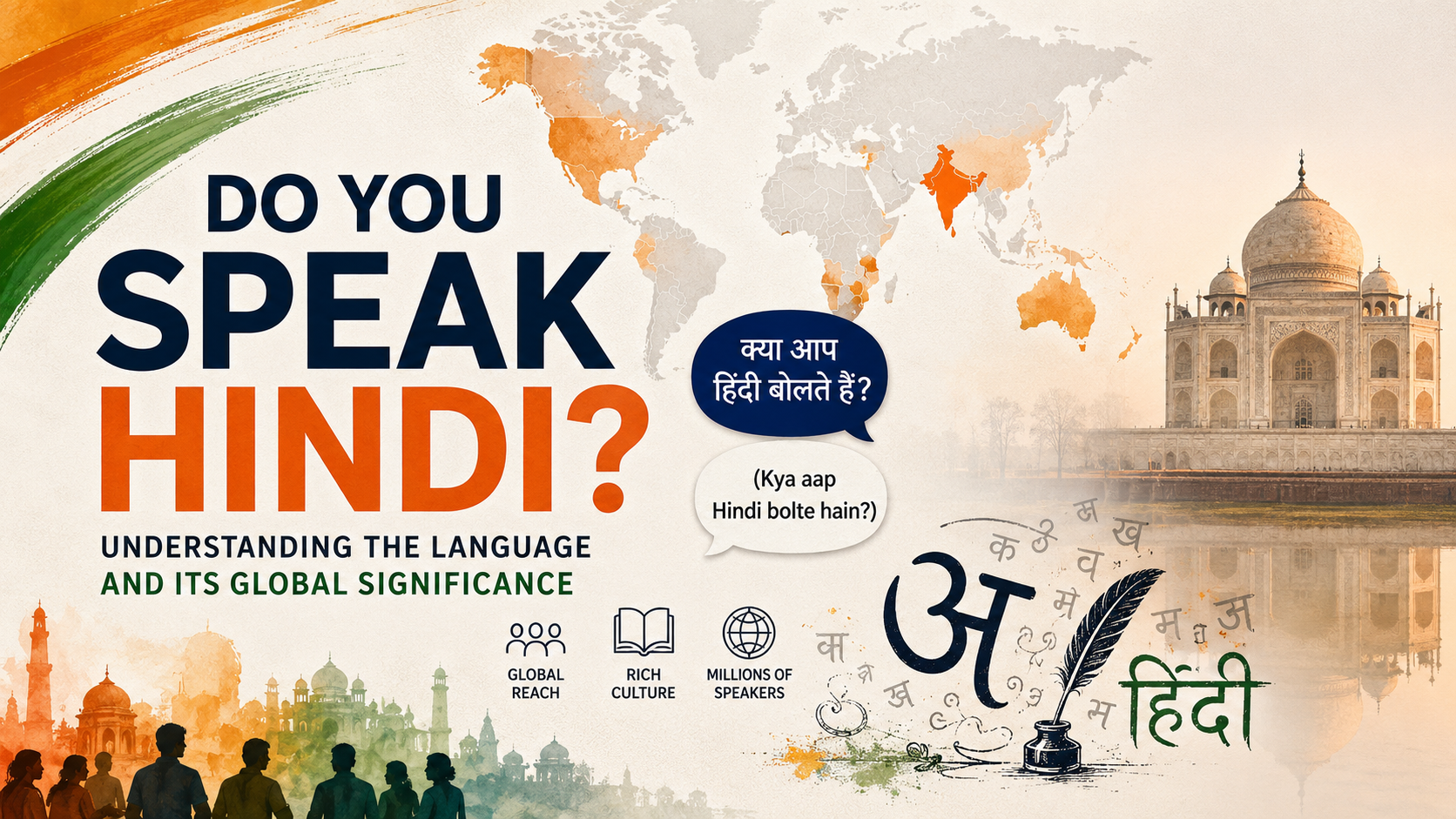

Hindi is one of the most spoken languages on the planet a living bridge between ancient civilizations and the modern world. Whether you've heard a Bollywood song, watched an Indian film, or simply encountered the phrase "do you speak Hindi?" in conversation, this language holds a magnetic pull that goes far beyond grammar. It is a gateway to nearly a billion people, a rich literary tradition, and a culture that has shaped global art, philosophy, and commerce for thousands of years.
If you've ever wondered how to say "do you speak Hindi?" in Hindi the answer is: क्या आप हिंदी बोलते हैं? (pronounced: Kya aap Hindi bolte hain?). This simple question opens a door to one of the world's most fascinating linguistic landscapes.
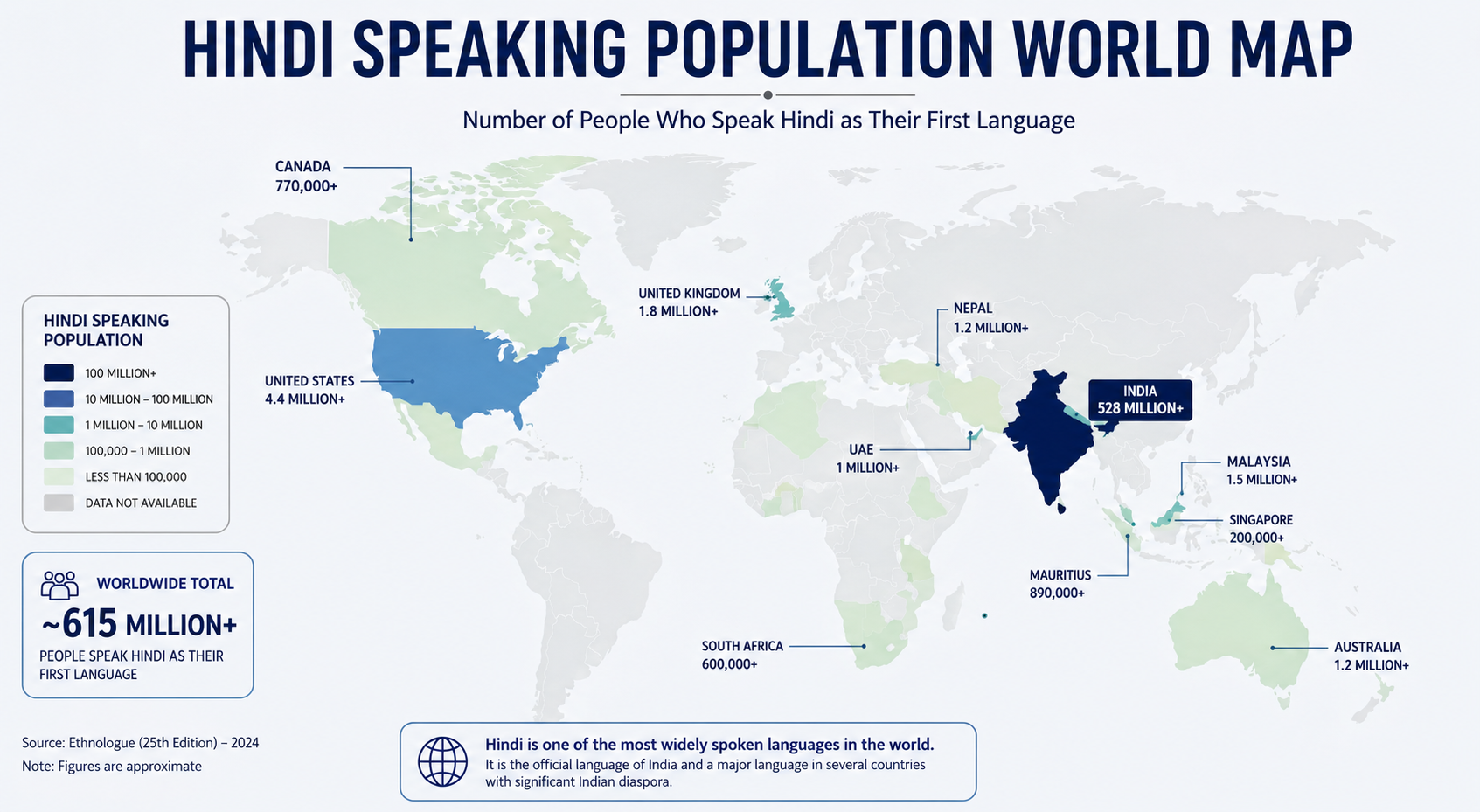
Hindi is the third most spoken language in the world by total number of speakers, with over 600 million people using it as their first or second language. That's more than twice the population of the United States!


The Global Reach of Hindi
How Large Is the Hindi Speaking Population Worldwide?
The hindi speaking population is staggeringly large and continues to grow. According to linguistic surveys, over 530 million people speak Hindi as their native language, while an additional 100–150 million use it as a second language across South Asia, Southeast Asia, and diaspora communities worldwide. This places Hindi firmly among the top three most spoken languages globally, alongside Mandarin Chinese and English.
Countries beyond India with notable Hindi-speaking communities include Nepal, Mauritius, Fiji, Trinidad and Tobago, Suriname, and South Africa all places where historical migration patterns carried the language far from the subcontinent. In the United Kingdom, Canada, and the United States, large South Asian diaspora communities keep Hindi alive and thriving as a heritage language. When someone asks "do you speak Hindi?" in these regions, the answer is often and proudly yes.
Hindi's Status in India
India is home to 22 officially recognized languages, yet Hindi holds a unique constitutional status. Alongside English, it serves as one of the two official languages of the Indian Union, used in Parliament, national courts, and central government communications. Hindi is the dominant language in a cluster of northern and central states commonly called the "Hindi Belt" which includes Uttar Pradesh, Bihar, Madhya Pradesh, Rajasthan, and Haryana.
These states alone account for hundreds of millions of speakers, making the hindi speaking population within India itself a powerful political and cultural force. Bollywood the world's most prolific film industry by output produces primarily Hindi-language films, ensuring the language reaches every corner of the subcontinent daily. Radio, television, and digital media have further cemented Hindi as the unofficial lingua franca of urban India.
Hindi and Urdu: Two Sides of the Same Coin
Common Origins and Mutual Intelligibility
One of the most fascinating aspects of South Asian linguistics is the difference between Hindi and Urdu in speaking or rather, how little difference actually exists in everyday conversation. Both languages descend from a common spoken ancestor called Hindustani, a vernacular that developed in the Delhi region during the Mughal era. For centuries, this was simply how people in northern India communicated, regardless of religious identity.
Today, if you place a Hindi speaker and an Urdu speaker in the same room, they can hold a natural, fluid conversation without any translation. The grammar, sentence structure, and most common vocabulary are virtually identical. The difference between Hindi and Urdu in speaking becomes most apparent only when the vocabulary shifts toward formal, literary, or domain-specific registers.
Hindi and Urdu are like two tributaries of the same river they share the same source, the same currents, but they carry different cultural sediment to different shores.
Dr. Rupert Snell, Linguist and Hindi Scholar, SOAS University of London
Differences in Script and Vocabulary
| Feature | Hindi | Urdu |
|---|---|---|
| Script | Devanagari (left to right) | Perso-Arabic / Nastaliq (right to left) |
| Primary Influences | Sanskrit | Persian, Arabic, Turkish |
| Formal Word for "Language" | Bhasha (भाषा) | Zaban (زبان) |
| Formal Word for "Water" | Jal (जल) | Aab (آب) |
| Spoken Overlap | ~90% mutual intelligibility | ~90% mutual intelligibility |
The key insight: the difference between Hindi and Urdu in speaking is subtle in casual conversation but grows more pronounced in literature, religion, and formal discourse. Hindi draws heavily on Sanskrit the classical language of ancient India while Urdu incorporates a rich Persian and Arabic vocabulary that reflects centuries of Islamic scholarly tradition.
This divergence becomes especially clear in poetry, legal texts, and religious sermons. A Hindi newspaper and an Urdu newspaper covering the same story may share identical spoken sentences yet look completely unrecognizable on the page one flowing left to right in rounded Devanagari curves, the other sweeping right to left in the elegant strokes of Nastaliq calligraphy. Same voice, different soul.
Learning Hindi: A Gateway to Rich Culture
Why You Should Learn to Do You Speak Hindi?
Learning Hindi opens a world that would otherwise remain behind a language barrier. Consider what becomes accessible: over 100 years of Bollywood cinema, one of the oldest living literary traditions in the world, the sacred texts of Hinduism and Jainism in their original forms, and the warm hospitality of hundreds of millions of people who will immediately connect with you more deeply the moment you attempt even a word of their language.
Practically speaking, knowing how to say "do you speak Hindi?" Kya aap Hindi bolte hain? before traveling to India transforms your experience. Locals in smaller cities and rural areas often speak limited English, and even in metropolitan areas like Delhi or Jaipur, a Hindi phrase earns a smile that no English sentence can replicate.
Benefits of learning Hindi at a glance:
- Access to 600+ million potential conversation partners globally
- Deeper engagement with Indian cinema, music, and literature
- Enhanced travel experiences in India, Nepal, and diaspora communities
- Career advantages in business, diplomacy, and tech sectors with strong India ties
- Cognitive benefits from learning a non-Latin script (Devanagari)
Resources for Learning Hindi
The good news for aspiring Hindi learners is that resources have never been more abundant. Structured online courses from platforms like Duolingo, Babbel, and specialized sites like HindiPod101 offer graded lessons that take you from zero to conversational. For those who prefer a more immersive approach, language exchange apps like Tandem or HelloTalk connect you directly with native Hindi speakers who want to practice English — a mutual arrangement that accelerates learning for both parties.
Community classes offered through Indian cultural organizations, universities, and local temples provide structured grammar instruction alongside a social environment that reinforces motivation. And perhaps the most underrated resource of all? Bollywood films with subtitles. Start with subtitles in your native language, graduate to Hindi subtitles, and eventually you'll find yourself understanding more than you expected.
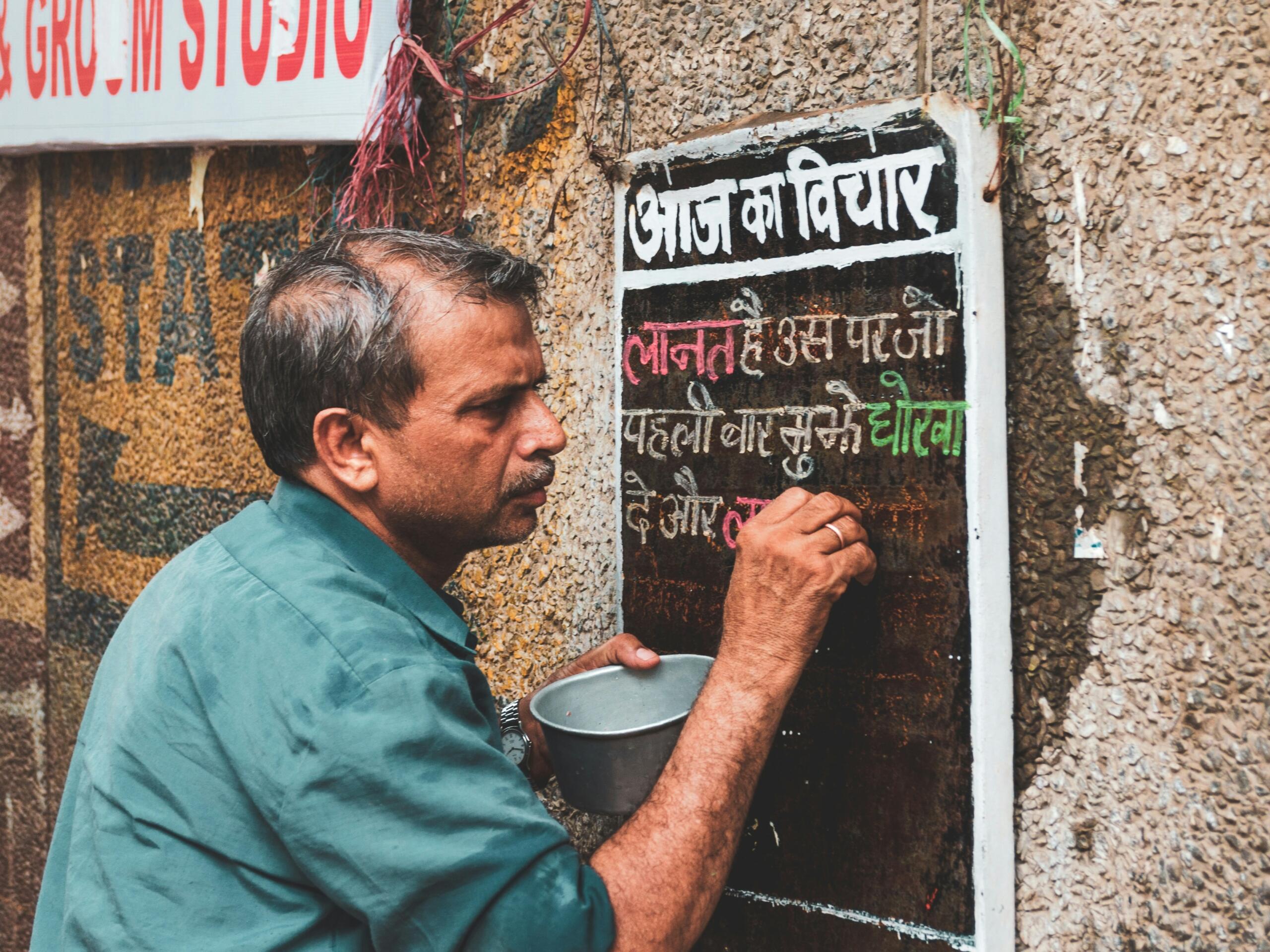
A street vendor writes today's thought ("Aaj Ka Vichar") in Devanagari script a everyday glimpse into how Hindi lives and breathes in Indian daily life. Photo: Akshat Vats / Unsplash
Practical Hindi Phrases for Beginners
Common Greetings and Expressions
Hindi (Devanagari)
- नमस्ते
- शुक्रिया
- कृपया
- माफ़ करना
- हाँ / नहीं
- आप कैसे हैं?
- मैं ठीक हूँ
Transliteration
- Namaste
- Shukriya
- Kripaya
- Maaf karna
- Haan / Nahin
- Aap kaise hain?
- Main theek hoon
Meaning
- Hello / Greetings
- Thank you
- Please
- I'm sorry / Excuse
- Yes / No
- How are you?
- I am fine
Asking About Language Proficiency
These phrases are especially useful when navigating conversations across language barriers:
क्या आप हिंदी बोलते हैं? Kya aap Hindi bolte hain? → Do you speak Hindi? (This is your main phrase practice it until it flows naturally!)
क्या आप अंग्रेज़ी बोलते हैं? Kya aap angrezi bolte hain? → Do you speak English?
मुझे हिंदी सीखनी है Mujhe Hindi seekhni hai → I want to learn Hindi
मैं थोड़ी हिंदी बोलता हूँ Main thodi Hindi bolta hoon → I speak a little Hindi
धीरे बोलिए, कृपया Dheere boliye, kripaya → Please speak slowly
मैं समझ नहीं पाया Main samajh nahi paya → I didn't understand
क्या आप फिर से कह सकते हैं? Kya aap phir se keh sakte hain? → Can you say that again?
मुझे शब्दकोश चाहिए Mujhe shabdkosh chahiye → I need a dictionary
Why Hindi Deserves a Place in Your Life
Language is never just a communication tool it is a worldview. When you learn to say "do you speak Hindi?" and genuinely mean it, you're stepping into a tradition of storytelling, philosophy, and human connection that stretches back millennia. The hindi speaking population represents one of the largest and fastest-growing linguistic communities in the digital age, with Hindi content on YouTube, Instagram, and streaming platforms exploding in the last decade.
The distinctions that once separated communities like the difference between Hindi and Urdu in speaking matter far less today than the shared humanity those languages express. Whether you are learning Hindi for travel, business, family connections, or pure intellectual curiosity, the journey begins with one question:
क्या आप हिंदी बोलते हैं? Kya aap Hindi bolte hain?
Do you speak Hindi?
Start today. The language will meet you halfway and if you want to get there faster, a native-speaking tutor on Superprof can take you from beginner to confident in no time.
Summarise with AI:
Did you like this article? Leave a rating!

 Loading...