
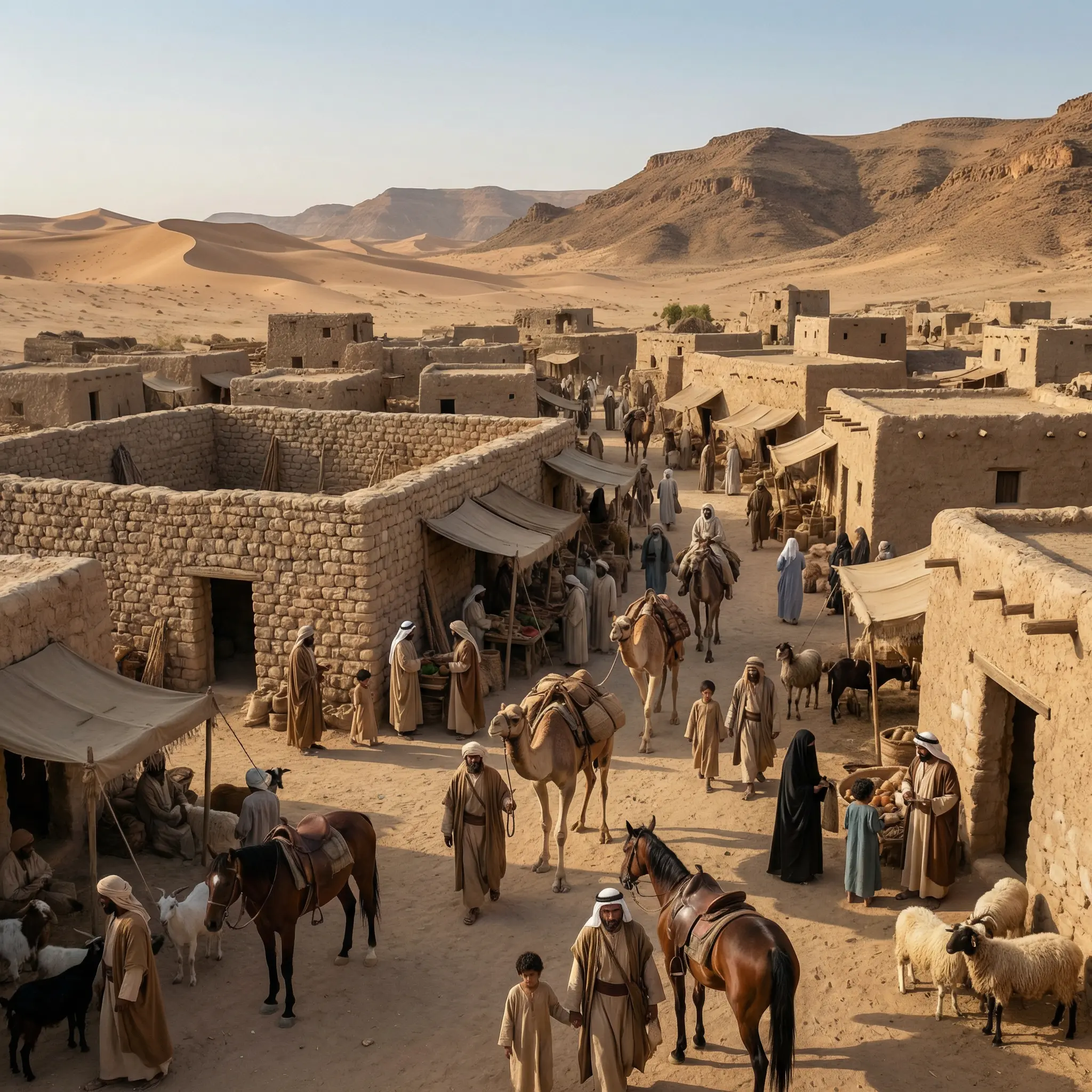

Few regions have shaped the course of human history as profoundly as the Arabian Peninsula. Stretching from the Red Sea to the Persian Gulf, this vast landmass has been home to ancient kingdoms, powerful trade networks, and the birthplace of one of the world's major religions. The history of the Arabian Peninsula is not simply a regional story it is a story of humanity itself, woven through millennia of migration, commerce, conflict, and belief.
From the earliest prehistoric settlements to the rise of mighty pre-Islamic kingdoms, and from the birth of Islam to its extraordinary expansion of Islam across continents, the peninsula has consistently stood at the crossroads of civilizations. Understanding this history means understanding how the ancient and medieval world was shaped and how echoes of that past still resonate today.


Prehistoric Roots and Early Human Settlements
The history of the Arabian Peninsula begins far earlier than most people realize. Archaeological evidence suggests that modern humans inhabited parts of the peninsula as early as 106,000 to 130,000 years ago, making it one of the first regions outside Africa to be settled by Homo sapiens. Early communities adapted remarkably to the harsh desert terrain, developing skills in navigation, water sourcing, and animal husbandry.
Over thousands of years, these early populations gave rise to increasingly complex societies. The peninsula's geographical position linking Africa, Asia, and the Mediterranean meant that it was never truly isolated a strategic crossroads that has defined its role in human history ever since. Trade winds, seasonal rains, and fertile highland zones in the southwest enabled agriculture and permanent settlement long before written records began early foundations of what would become the world's most strategically positioned landmass.
Ancient Kingdoms and the Power of Southern Arabia
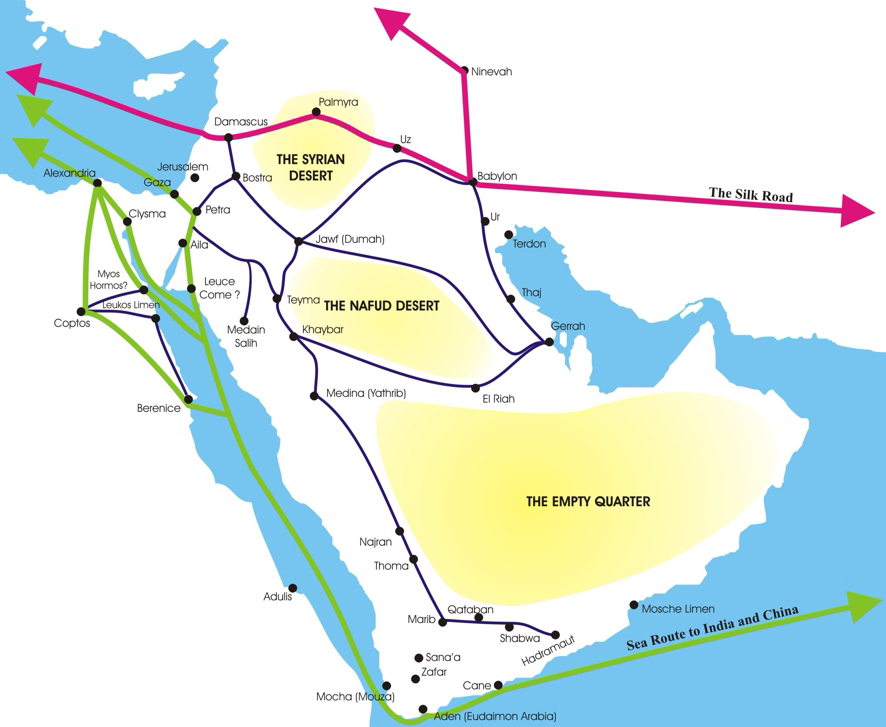
Some of the most remarkable chapters in the history of the Arabian Peninsula come from its ancient southern kingdoms. The Sabaean Kingdom often associated with the biblical land of Sheba flourished in present-day Yemen from roughly the 10th century BCE onward. It was a civilization of extraordinary wealth, built on the control of frankincense and myrrh trade routes made possible by an intimate knowledge of the peninsula's winds, seasons, and terrain.
Following the Sabaeans, the Himyarite Kingdom rose to dominance, eventually controlling most of southern Arabia by the 2nd century CE. The Himyarites were notable not only for their military power but also for their religious evolution shifting from polytheism toward monotheism in the centuries just before Islam emerged.
In the north and center of the peninsula, the Nabataean Kingdom carved one of antiquity's most breathtaking monuments into rose-red rock: the city of Petra, now in modern Jordan. Meanwhile, the Kingdom of Kinda held considerable influence over central Arabian tribes, foreshadowing the complex tribal politics that would define the region for centuries to come.
The Incense Route controlled by ancient Arabian kingdoms was one of antiquity's most profitable trade networks, rivaling the Silk Road in its economic and cultural importance.
Arabian Peninsula Before Islam: Society, Faith, and Commerce
To truly understand the emergence of Islam, one must first understand the Arabian Peninsula before Islam a world of extraordinary complexity often reduced to simplistic stereotypes. Far from being a "blank slate," pre-Islamic Arabia was a sophisticated mosaic of tribal confederacies, merchant cities, nomadic pastoralists, and settled agricultural communities.
Socially, tribal identity was the foundation of everything. Loyalty to one's clan determined legal rights, social standing, and even access to water and grazing land. The Arabian Peninsula before Islam was governed not by centralized states but by a web of alliances, feuds, and negotiated agreements between tribes a system both resilient and prone to devastating inter-tribal warfare.
Religiously, the peninsula hosted a surprising diversity of beliefs. While polytheism was dominant centered on a pantheon of gods housed at sacred sanctuaries like the Kaaba in Mecca there were significant Jewish communities in places like Medina and Christian populations in Najran — regions that today fall within the borders of modern Saudi Arabia and Yemen. This religious plurality made the Arabian Peninsula before Islam a uniquely fertile ground for the emergence of a new monotheistic faith.
Economically, the peninsula was anything but peripheral. Mecca, strategically located on the western trade corridor, had grown into one of the most important commercial hubs in the region. Caravans carrying spices, textiles, gold, and incense passed through its markets, and the city's merchant elite including the Quraysh tribe had built considerable wealth from this trade.
At the heart of pre-Islamic Arabia stood Mecca and its sacred precinct, the Kaaba. Believed to have been built by Abraham and his son Ishmael according to later Islamic tradition, the Kaaba housed hundreds of idols representing the deities of various Arabian tribes. Its religious significance drew pilgrims from across the peninsula, turning Mecca into both a spiritual and commercial center a combination that gave the city and its ruling Quraysh tribe enormous influence.
The Rise of Islam and the Transformation of the Peninsula
In 570 CE, in the city of Mecca, a child was born who would irrevocably alter the history of the Arabian Peninsula and the world. Muhammad ibn Abdullah, orphaned young and raised by his uncle Abu Talib, grew into a respected merchant known for his honesty and contemplative nature. At around the age of 40, in 610 CE, he began receiving what he described as divine revelations through the Angel Gabriel revelations that would form the text of the Quran.
His message of one God, social justice, and the equality of all believers resonated with many but threatened the established order of Mecca's polytheistic merchant elite. Persecution followed. In 622 CE, Muhammad and his followers made the pivotal migration the Hijra to the city of Medina. This moment is so significant that it marks the start of the Islamic lunar calendar.
In Medina, Muhammad transformed from a religious preacher into a statesman and military commander. By 632 CE, the peninsula's fractious tribal landscape had been unified under a single Islamic state for the first time laying the demographic and cultural foundations for a region that today is home to nearly 100 million people.
570 CE
Birth of Prophet Muhammad in Mecca
610 CE
First revelation; beginning of the Quran
622 CE
The Hijra (Migration to Medina); Islamic calendar begins
630 CE
Conquest of Mecca; Arabia begins to unify
632 CE
Death of Muhammad; unified Islamic state established on the peninsula
The Expansion of Islam: From the Peninsula to the World
The expansion of Islam following Muhammad's death was one of the most rapid and far-reaching transformations in the history of human civilization. Under the Rashidun Caliphs — Abu Bakr, Umar, Uthman, and Ali Arab armies swept across the Persian Empire, Byzantine territories in the Levant and Egypt, and North Africa within just a few decades.
The expansion of Islam was not merely military. In many regions, it was welcomed by populations exhausted by Byzantine or Persian taxation and religious persecution. The new Islamic order promised relative religious tolerance for "People of the Book" (Jews and Christians), fair taxation, and an end to the old imperial hierarchies.
Under the subsequent Umayyad Caliphate, the pace of conquest accelerated further. By 711 CE, Muslim armies had crossed into the Iberian Peninsula (modern Spain and Portugal) in the west, and reached the borders of the Indian subcontinent in the east. Within a century of the Prophet's death, Islam had become the religion of an empire stretching from the Atlantic to Central Asia a transformation unmatched in speed by any previous civilization.
The Arabs burst out of the desert in a conquest that in its dramatic rapidity and extent has no parallel in the history of the world.
Philip K. Hitti, History of the Arabs
The expansion of Islam did not only bring military conquest it ignited an era of unparalleled intellectual achievement. From the 8th to the 14th century, the Islamic world became the global center of science, mathematics, medicine, astronomy, and philosophy. Scholars in Baghdad, Cordoba, Cairo, and Samarkand preserved and advanced the knowledge of ancient Greece, Persia, and India, transmitting it to a Europe still emerging from its Dark Ages.
Algebra, algorithms, optics, and modern surgery all have roots in this Islamic Golden Age — a direct legacy of the civilization born on the Arabian Peninsula.
Ottoman Rule, Oil, and the Modern Arabian Peninsula
The history of the Arabian Peninsula took another dramatic turn with the rise of the Ottoman Empire. By the 16th century, much of the peninsula had fallen under Ottoman suzerainty though the interior remained largely autonomous, governed by local tribes and religious leaders. Ottoman control brought administrative organization but also resentment, particularly in the Hijaz (the western coastal region containing Mecca and Medina).
The decline of Ottoman power in the 19th and early 20th centuries opened space for new political formations. The most significant was the rise of the Al Saud dynasty in central Arabia, which, allied with the religious reform movement of Wahhabism, eventually unified most of the peninsula as the Kingdom of Saudi Arabia in 1932.
Then came the discovery that would remake the region and the global economy forever. Oil was first commercially extracted in Bahrain in 1932, followed by Saudi Arabia in 1938. Within decades, the Gulf states of Saudi Arabia, Kuwait, the UAE, Qatar, and Bahrain had transformed from among the world's poorest regions to among its wealthiest, reshaping global geopolitics in the process.
Summarise with AI:
Did you like this article? Leave a rating!

 Loading...